

Leather Goods Market Set for 6.7% CAGR Through 2035 as Premiumization, Online Retail and Accessories Drive Growth
Leather Goods Market
Leather Goods Market is projected to reach USD 916.3 billion by 2035, driven by premiumization, digital retail, accessories and evolving consumer preferences.
Craftsmanship, innovation and responsible materials are redefining the next generation of luxury.”
NEW YORK, NY, UNITED STATES, August 25, 2026 /EINPresswire.com/ -- — Industry Market Analysis
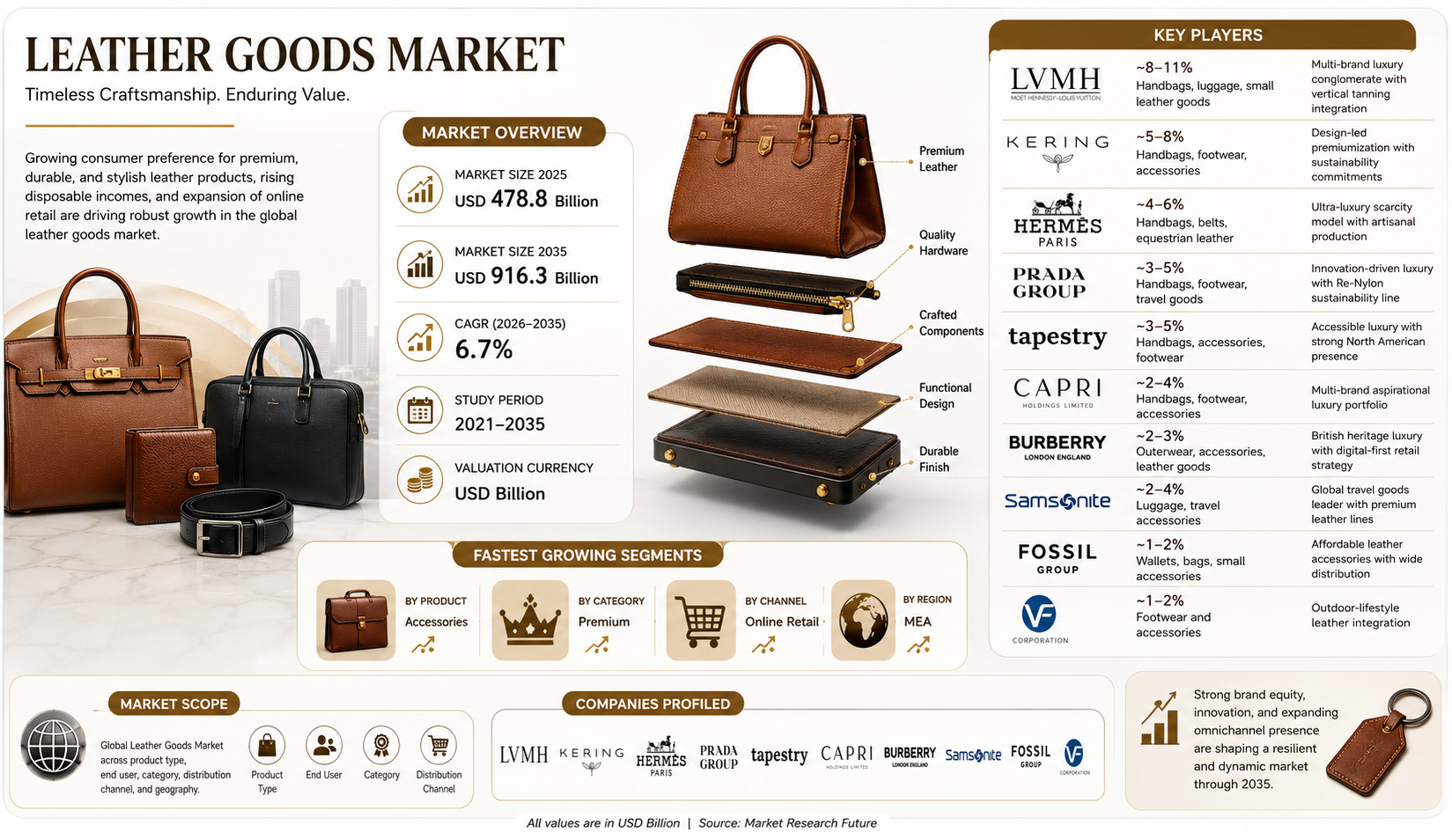
The global Leather Goods Market is entering a sustained growth phase as consumers increasingly combine functionality, craftsmanship, durability and fashion in purchasing decisions. The market is valued at USD 478.8 billion in 2025 and is projected to reach USD 916.3 billion by 2035, expanding at a 6.7% CAGR from 2026 to 2035. Growth is supported by rising disposable incomes, premium lifestyle consumption, expanding travel activity, brand-driven purchasing and the increasing role of digital commerce in product discovery and transactions.
The competitive landscape remains fragmented across luxury, premium, accessible-luxury and mass-market categories. LVMH Moët Hennessy Louis Vuitton holds an estimated 8–11% revenue share range through brands such as Louis Vuitton, Celine and Loewe, while Kering SA accounts for approximately 5–8% through Gucci, Bottega Veneta and Balenciaga. Hermès International maintains a differentiated ultra-luxury position based on scarcity and artisanal craftsmanship. Other significant participants include Prada Group, Tapestry Inc., Capri Holdings, Burberry Group, Samsonite International, Fossil Group and VF Corporation, each targeting different combinations of luxury, travel, lifestyle, accessibility and geographic reach.
"Free Sample Copy" - Access A Complimentary Copy of Our Report to Explore Its Content and Insights
https://www.marketresearchfuture.com/sample_request/10731
Market Dynamics and Key Growth Drivers
One of the strongest drivers is premiumization. Consumers are increasingly willing to pay for recognizable brands, superior craftsmanship, distinctive design and products perceived to offer long-term value. Premium handbags, wallets, belts, footwear, luggage and travel accessories benefit from this shift because leather is associated with durability and tactile quality. Luxury houses are also strengthening customer loyalty through limited editions, personalization, heritage storytelling and exclusive collections.
Another important factor is the expansion of online retail. Digital platforms have transformed how consumers compare brands, evaluate product specifications and discover new leather goods. Luxury and premium companies are investing in direct-to-consumer websites, mobile commerce, social commerce, virtual consultations and omnichannel fulfillment. Online retail is particularly important for accessories and small leather goods because these products are comparatively easy to display, ship and purchase without an extensive physical-store experience.
Changing lifestyles are also supporting demand. Urban professionals, frequent travelers and fashion-conscious consumers require products that combine appearance with practical utility. Bags, luggage, backpacks, footwear, belts and wallets increasingly function as lifestyle products rather than purely functional possessions.
Product Type Analysis
The market can be broadly examined through footwear, handbags, luggage, wallets and purses, belts, accessories and other leather products. Handbags remain an important value generator because of strong luxury-brand participation and frequent collection launches. High-end handbags also benefit from resale markets, collectible appeal and brand recognition.
Accessories are projected to be the fastest-growing product segment. This category includes wallets, card holders, belts, small bags, cases and other compact products. Lower absolute purchase prices compared with large luxury goods make accessories an accessible entry point for consumers seeking premium brands.
Luggage and travel goods represent another important opportunity. International travel recovery, business mobility and demand for durable premium luggage are supporting product innovation. Companies such as Samsonite have increasingly combined lightweight construction, functionality and premium materials to differentiate products.
Category Analysis
By category, the market includes premium, mass and other positioning levels, with premium products expected to be the fastest-growing segment. Premiumization is extending beyond traditional luxury customers as aspirational consumers prioritize fewer but higher-quality purchases.
The premium category benefits from stronger brand equity, craftsmanship, design differentiation and perceived durability. Luxury companies also maintain pricing power through controlled distribution and limited availability. Meanwhile, mass-market products continue to serve consumers seeking affordability and everyday functionality, creating a broad volume base for the industry.
End-User Analysis
The men's, women's and unisex segments address different purchasing patterns. Women's leather goods remain particularly significant because of handbags, purses, footwear and fashion accessories. Men's demand is expanding across wallets, belts, business bags, footwear, travel products and increasingly fashion-oriented handbags.
The unisex segment is gaining relevance as minimalist design, gender-neutral fashion and versatile products become more common. Brands are responding with cross-category collections that emphasize functionality, neutral silhouettes and flexible styling.
Distribution Channel Analysis
Distribution is divided between store-based and non-store-based channels. Physical stores remain important for luxury leather goods because consumers often want to assess material quality, craftsmanship, fit and finishing before purchase. Flagship stores also provide brand immersion and personalized service.
However, online retail is expected to be the fastest-growing distribution channel. E-commerce allows brands to reach international customers while supporting product launches, personalized recommendations and direct customer relationships. Digital channels are also becoming increasingly relevant for younger consumers who begin their purchasing journey through search, social media and online marketplaces.
Regional Analysis
Geographically, the market covers North America, Europe, Asia-Pacific and the Middle East & Africa (MEA). North America benefits from strong premium consumption, established luxury retail infrastructure and high e-commerce penetration. Europe remains strategically important because of its concentration of luxury brands, craftsmanship clusters and fashion capitals.
Asia-Pacific represents a major long-term growth engine because of expanding middle- and high-income consumer populations, urbanization and growing interest in international luxury brands. MEA is projected to be the fastest-growing regional segment, supported by luxury tourism, premium retail development, rising consumer spending in key markets and increasing investment in sophisticated retail infrastructure.
"Proceed To Buy" - Move Forward with Your Purchase and Gain Instant Access to the Complete Report
https://www.marketresearchfuture.com/checkout?currency=one_user-USD&report_id=10731
Competitive Landscape
Competition is increasingly based on more than product design. LVMH combines a broad luxury portfolio with vertical integration and established leather-goods expertise. Kering emphasizes design-led premiumization across Gucci, Bottega Veneta and other houses. Hermès maintains an ultra-luxury scarcity model supported by artisanal production and controlled supply.
Prada Group focuses on innovation, design and material development, while Tapestry emphasizes accessible luxury and its strong North American footprint. Capri Holdings operates a multi-brand aspirational luxury portfolio. Burberry leverages British heritage and digital retail capabilities, while Samsonite brings global travel-goods expertise. Fossil maintains broad distribution in affordable accessories, and VF Corporation integrates leather products into outdoor and lifestyle footwear and accessories.
Industry Developments
1. Luxury brands are accelerating sustainability and circularity initiatives. In April 2026, Louis Vuitton introduced its Regeneration 2030 roadmap, emphasizing eco-design, circular creativity, sustainable operations and resource efficiency. The initiative includes efforts around reuse, reworking and recycling materials.
2. Leather production capacity and material innovation are expanding simultaneously. Hermès is continuing investments in leather-goods manufacturing capacity, including a new workshop in Loupes and additional projects planned through 2030. Meanwhile, Kering has strengthened its material strategy around traceability, alternative materials, repair, certified resale and digital product passports.
Market Outlook
The Leather Goods Market is expected to evolve toward a more sophisticated combination of craftsmanship, premiumization, digital commerce, personalization, sustainability and functional design. The projected increase from USD 478.8 billion in 2025 to USD 916.3 billion by 2035 indicates substantial room for expansion across established and emerging product categories.
The industry's next phase will depend increasingly on how companies balance traditional leather craftsmanship with changing expectations around traceability, material efficiency and responsible production. At the same time, online retail and emerging-market consumption will broaden access to leather goods, while premium and luxury brands continue using scarcity, heritage and innovation to maintain differentiation.
Frequently Asked Questions
1. What is the projected size of the Leather Goods Market by 2035?
The global Leather Goods Market is projected to reach USD 916.3 billion by 2035, compared with USD 478.8 billion in 2025.
2. Which segments are expected to grow fastest in the Leather Goods Market?
Accessories, premium products, online retail and the Middle East & Africa (MEA) are identified as the fastest-growing segments across their respective classifications.
Read Our Related Research Report
Leather Luggage and Goods Market -
https://www.marketresearchfuture.com/reports/leather-luggage-and-goods-market-33644
Personal Luxury Goods Market -
https://www.marketresearchfuture.com/reports/personal-luxury-goods-market-22976
Luxury Goods Market -
https://www.marketresearchfuture.com/reports/luxury-goods-market-11629
Sagar Kadam
Market Research Future
+1 628-258-0071
email us here
Legal Disclaimer:
EIN Presswire provides this news content "as is" without warranty of any kind. We do not accept any responsibility or liability for the accuracy, content, images, videos, licenses, completeness, legality, or reliability of the information contained in this article. If you have any complaints or copyright issues related to this article, kindly contact the author above.
